
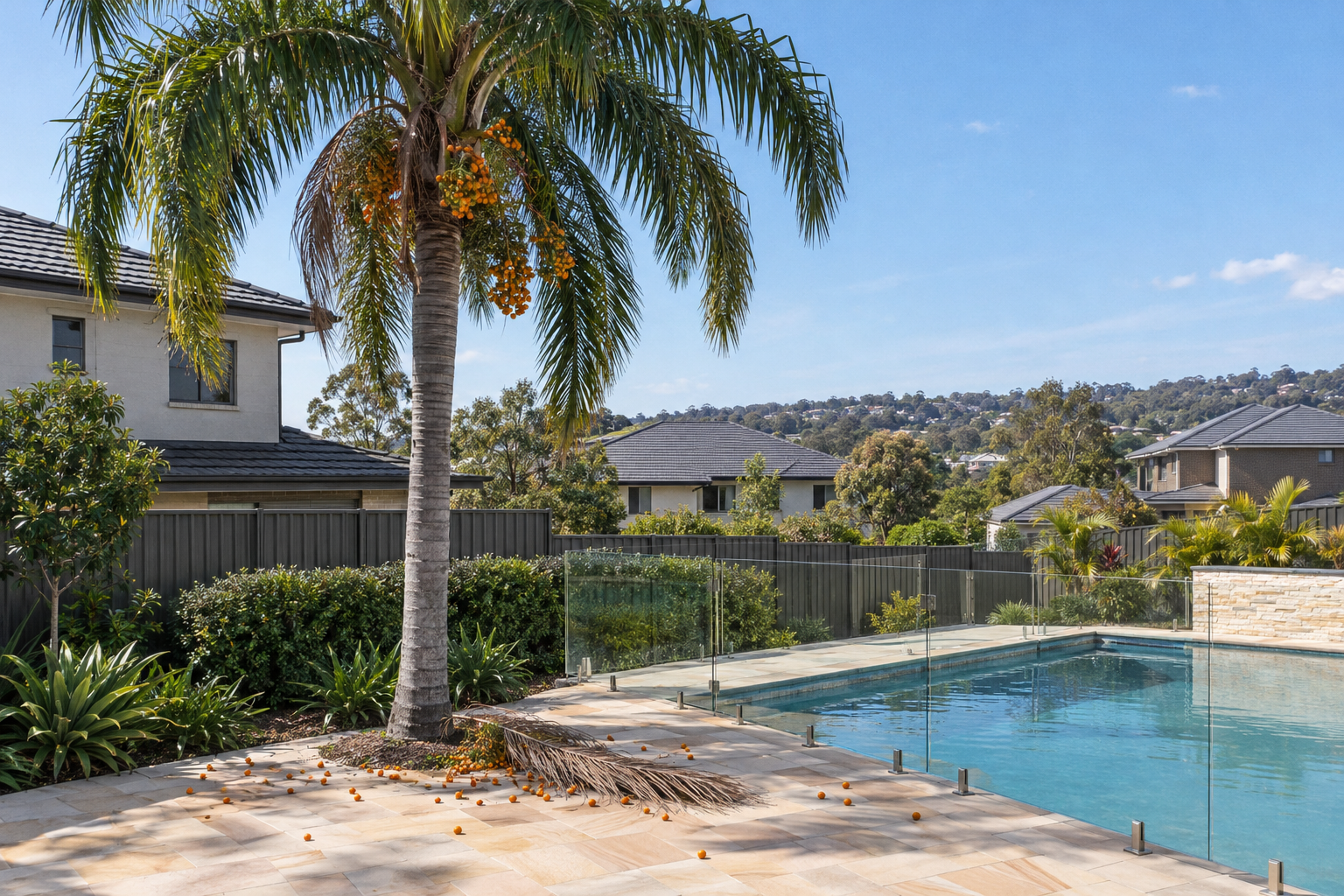
The cocos palm beside the pool probably looked neat when the house went up. Many years on it's taller than the roofline, with sticky orange fruit across the pavers, flying foxes squabbling in it at night, and a frond the size of a canoe on the lawn after every westerly. If that's your backyard in Kellyville, Rouse Hill or Castle Hill, you're far from the only one wondering whether it should stay.
Why the cocos palm is everywhere in the Hills
The cocos, or queen palm, was a default planting for a long stretch of Sydney's suburban growth. It's cheap, quick to establish and gives an instant resort look. That made it a favourite around pools in the 1970s and 80s on the older Castle Hill and Baulkham Hills blocks, and again in the estates that went in across Kellyville, Rouse Hill and Beaumont Hills from the late 90s on.
The trouble is what it does once it matures. A young cocos at fence height is a different plant from a mature one. They commonly reach well over 10 metres, and on a smaller estate block that puts the crown over the roof, the pool, the neighbour's yard or the overhead lines.
The fruit is the main complaint
Cocos palms flower and then hang heavy clusters of small orange fruit. Through the warmer months those clusters ripen and drop, and that's when most people start looking up removal.
What the fruit tends to do:
- Rots where it lands. It ferments in the sun, smells, draws ants and flies, and can stain light-coloured pavers and concrete.
- Gets into the pool. Fruit and fibre end up in skimmer baskets and filters, and the pool needs more attention through the fruiting season.
- Makes paths slippery. Squashed fruit on a pool surround or a sloping driveway is a genuine slip hazard, especially for older people and kids.
- Sprouts. Dropped seed germinates readily in garden beds and between pavers. You end up pulling cocos seedlings for years.
Flying foxes and the night shift
Ripe cocos fruit is a reliable food source for flying foxes, and for lorikeets and other birds during the day. On a warm night a fruiting palm can host a lot of noisy feeding, followed by droppings on cars, Colorbond roofs, outdoor furniture and whatever is on the Hills Hoist.
Worth knowing: the grey-headed flying fox is a protected, threatened species. You can deal with the palm, but nobody should be trying to harm or trap the animals, and netting a palm badly can tangle wildlife. If the palm is the attraction, the palm is the thing to address.
Why the seedlings matter on acreage
On the larger blocks in Glenhaven, Dural and Kenthurst that back onto remnant bushland, cocos seed is more than a gardening nuisance. Birds and flying foxes carry it, and cocos is widely regarded as an environmental weed in parts of eastern Australia because it can establish in bushland edges and creek lines. If your block runs into bush, a fruiting cocos is seeding further than your own garden.
Fronds and the old frond bases
Cocos palms don't shed their old fronds cleanly. Dead fronds hang down as a brown skirt and eventually drop, along with the woody boat-shaped spathes left over from flowering. A mature frond is long and surprisingly heavy, and it can come down without much warning in a gusty spring westerly or a summer southerly buster.
That's usually tolerable over lawn. It's a different matter over a glass pool fence, a pergola, a parked car or a play area.
Do the roots cause damage?
This is one area where cocos palms get blamed for more than they do. Palms have a fibrous root system rather than the thick spreading woody roots of something like a liquidambar or a camphor laurel. In most cases they don't lift driveways the way broadleaf trees can. That doesn't make them harmless near old cracked pipes or a pool shell, but if roots are your only concern, it's worth getting someone to look before assuming the palm is the cause.
Cleaning versus removal
There are two realistic options, and which one makes sense depends on the palm, where it sits and what's bothering you.
Option one: keep it and clean it
A palm clean means a qualified arborist removes the dead fronds, the old spathes and the flower and fruit stalks. It tidies the palm, takes away the hanging weight that would otherwise fall, and cuts the fruit drop if the stalks are taken before they ripen.
The catch is that a cocos keeps producing. Cleaning is ongoing maintenance, not a fix. Some people are happy with that because they like the look of the palm. Our palm removal and cleaning page covers what's involved, and cleaning starts from about $150 per palm.
Cleaning tends to make sense when:
- the palm is well clear of the house, pool and boundary
- you like it and the fruit is the only real complaint
- you're comfortable with a repeat job as part of normal yard upkeep
Option two: take it out
Removal tends to make sense when:
- the crown sits over the roof, pool, a neighbour's yard or overhead lines
- the fruit, flying foxes and seedlings have outweighed the look of it
- you're on bushland-edge acreage and don't want to keep seeding the bush
- you'd rather plant something that suits the space
With no branches to deal with, a cocos is often a simpler removal than a broadleaf tree of the same height. Simpler isn't the same as easy, though. The crown is heavy, the trunk is dense and fibrous, and on a tight estate block with a pool on one side and a neighbour's fence on the other, the palm usually has to come down in controlled sections rather than in one fall. That's work for a qualified arborist with proper rigging.
What drives the cost of removing one
Palms vary in price for the same reasons trees do. Height matters, but what's under the palm matters more. A cocos in the middle of an open lawn with good access is a straightforward job. The same palm leaning over a pool fence, a tiled roof and the neighbour's shed, at the end of a narrow side path, takes more time, more rigging and more care.
The things to tell whoever quotes it:
- roughly how tall it is, compared with the house
- what's directly underneath and within falling distance
- how wide the side access is and whether there are steps
- whether you want the stump ground out as well
Palm stumps can be ground out like any other. Ground 200 to 300 mm below the surface, the spot can be filled and turfed or replanted.
Check the council side first
Whether a cocos palm needs approval to remove depends on your council and your property. Most of the Hills is The Hills Shire, Cherrybrook is Hornsby, North Rocks and Northmead are City of Parramatta, and several suburbs straddle boundaries, so your neighbour's situation won't necessarily be yours. Check the council's current controls before booking anything. Our council tree approval guide explains how the system generally works.
Planting something better in its place
If the palm goes, think about what the space actually needs. On a smaller Kellyville or Rouse Hill block, that usually means something that stays in proportion to the yard, doesn't drop heavy fruit onto a pool surround, and won't tower over the roof in twenty years. A water gum is a common choice for that kind of spot. Whatever you choose, look up its mature height and spread before it goes in. Most cocos problems began as a small palm planted without that check.
Next step
If you're weighing up a clean against removal, a couple of photos of the whole palm, plus what's underneath it and the access path, is usually enough for a ballpark. You can send them through our quote form.