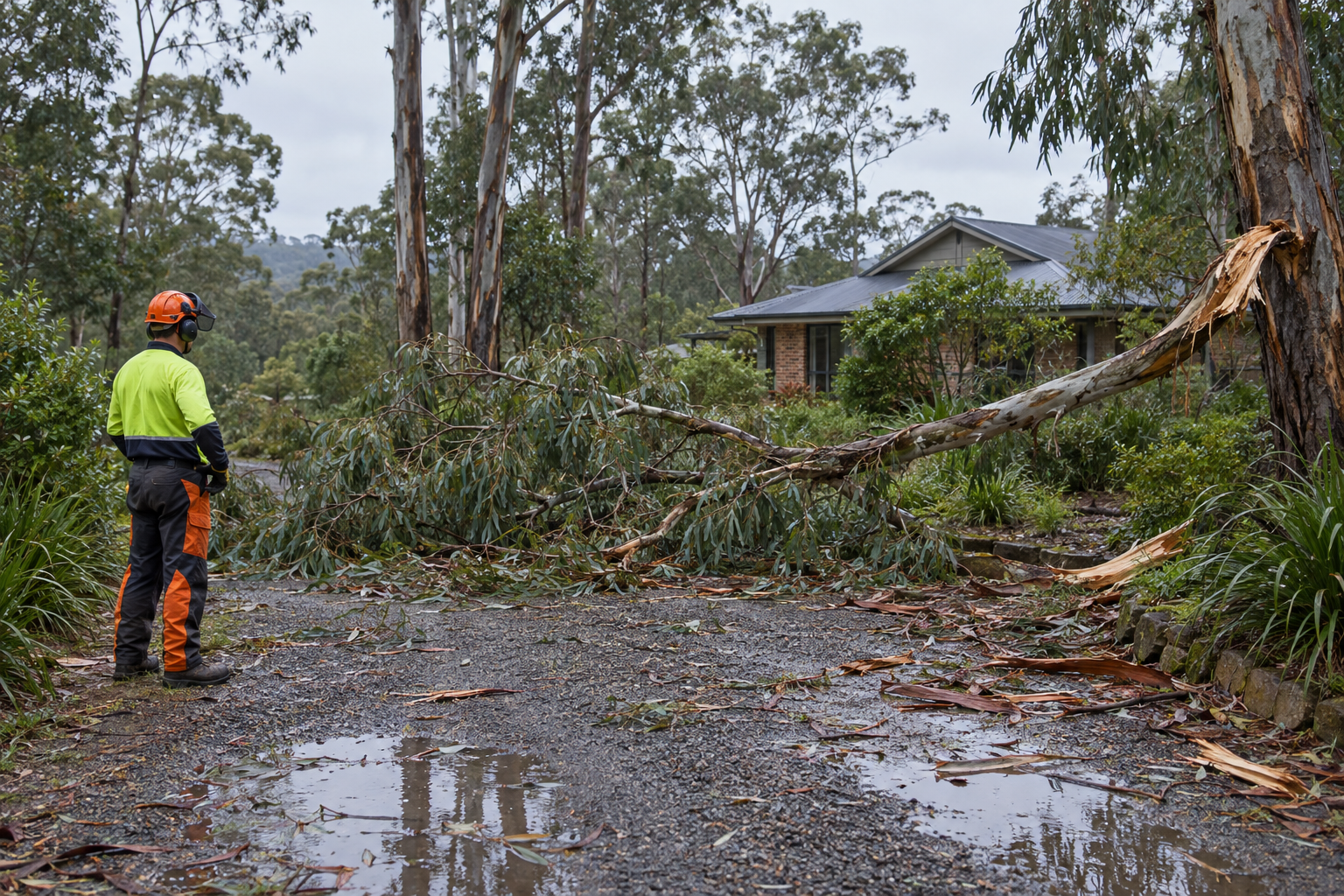
The southerly has come through, the lights have flickered, and there's a blue gum limb across the gravel drive of your Dural block. Or a whole tree is leaning on the Colorbond fence between you and the house next door in Kellyville. What you do in the next hour decides whether this stays a property problem or becomes something worse.
This is the order we'd work through it.
Is anyone hurt, and is anything live?
People first, then power, then everything else.
- Anyone injured or trapped: call 000. Don't try to lift or cut timber off someone yourself. A trunk that seems to be resting can shift as soon as weight comes off one side.
- Tree on the house with people inside: get everyone out through a door away from the damage, and keep them out until someone qualified has looked at it.
- You smell gas: leave, keep well away, and call 000 from a distance.
- Structural damage or a tree blocking the house, and you need help making it safe: the NSW SES takes storm calls on 132 500.
If nobody is hurt and nothing is live, you have time. Use it to slow down, not speed up.
Stay well away from powerlines
Assume any wire on the ground or tangled in a fallen tree is live, even if the power is off. Lines can be re-energised without warning, and a wet tree or wet ground can carry current. The usual public advice is to stay at least eight metres away and keep kids and pets inside.
Call your electricity distributor, not an electrician and not a tree company. Endeavour Energy covers most of the Hills District. Parts of the Hornsby side, including around Cherrybrook, are on the Ausgrid network. Check your bill if you're not sure. If a line is down across a road or footpath, call 000 as well.
No arborist should touch a tree that is in contact with a powerline until the network has made it safe. Anyone at your gate offering to cut it straight away is telling you something about how they work.
A tree that has moved once can move again
A fallen tree doesn't always mean a finished one. Some of the most dangerous situations after a storm look calm.
- Hung-up limbs. A broken branch caught in the canopy, sometimes 15 metres up in a tall gum, can drop with the next gust or with no gust at all. These are common in the big blue gums and blackbutts on the acreage blocks around Glenhaven and Kenthurst.
- A lifted root plate. If one side of the ground around the base has heaved up, the tree has partly failed at the roots. It may settle back, or it may keep going.
- A tree resting on another tree, the house or the fence. Whatever it's leaning on is holding it up. Move that support and the load goes somewhere you didn't plan.
Keep people out of the zone a falling tree could reach, which is roughly its full height in every direction it could go. On a tight estate block that might mean keeping clear of part of your own yard and the neighbour's too.
Take photos before anything moves
If you take one practical step in the first hour, make it this one. Insurers want to see the damage as it happened, and it is far easier to photograph a scene than to rebuild it from memory.
- Wide shots showing the whole tree and where it landed.
- Close-ups of damage to the roof, gutters, fence, cars or sheds.
- The base of the tree and the break point, if you can see them safely from a distance.
- Anything inside: ceiling stains, broken tiles, water coming in.
Then call your insurer, or lodge the claim online, before you arrange removal if you can. Policies differ on what they cover, whether they want to send an assessor first, and whether they'll pay for removal of a tree that fell without damaging anything. Your insurer is the one who can tell you, and asking before work starts avoids an argument later.
The photos help with council too. Most councils make some allowance for trees that are an immediate danger, but what counts as an emergency and what evidence they want afterwards varies. We cover how that generally works on our council tree approval page. The short version: keep a record.
Leave the chainsaw in the shed
This is where weekend injuries happen after a storm. Timber from a fallen tree is rarely sitting still. Branches pinned under the trunk are often bent like a drawn bow, and cutting the wrong one releases that tension sideways at speed. A trunk propped on its own limbs can roll when one is cut. None of that is obvious until it happens.
The safe things to do yourself are limited:
- Rake small twigs and leaves off paths and out of gutters you can reach from the ground.
- Drag loose, unattached branches small enough to lift easily out of a doorway or off the driveway.
- Tarp a broken window from inside, if it's safe to be in that room.
Anything under tension, anything above head height, anything on a roof and anything you'd need a ladder for is a job for a qualified arborist. On roofs especially, wet tiles and a shifting limb are a bad combination.
If it's on the house
Tall gums over roofs are part of living in Cherrybrook and West Pennant Hills, and a limb through the tiles is the scenario people dread most. Don't go into the roof space or onto the roof to look. Keep everyone out of rooms under the impact. Turn off the power at the switchboard only if you can reach it safely and it isn't wet. If in doubt, leave it and tell your distributor.
Getting a large section of tree off a roof without causing more damage usually means taking it apart in pieces and lowering each one on ropes, sometimes with a crane where access allows. That is planned work, even when it's urgent. Our emergency storm damage page explains how that side is handled.
If it came from next door
On the smaller estate blocks in Kellyville, Rouse Hill and Beaumont Hills, a fallen tree often lands across a boundary. The first hour is not the time to settle who pays. Make sure everyone is safe, tell your neighbour what's happened if they aren't home, take your photos, and let both insurers sort out the details. Who ends up responsible depends on the circumstances and your policies, not on whose side most of the tree landed.
If you share a fence, agree on one thing straight away: nobody starts cutting until the tree has been looked at.
Watch who knocks after the storm
After a big storm through the Hills, unsolicited crews tend to appear in streets with obvious damage. Some offer a cash price on the spot, want a deposit, or push to start before you've spoken to your insurer. Ask for a public liability insurance certificate, ask who will actually do the climbing and what qualifications they hold, and don't feel rushed. A tree that's already on the ground can wait an hour while you check.
Once it's safe
When the immediate danger is dealt with, the clean-up is a normal job with a normal quote. Work should be carried out by qualified, insured arborists, with AQF Level 3 climbers doing the work at height. We quote fixed price, with clean-up and green waste removal included. If the tree is down but the stump is still there, that can be ground out later as a separate step.
If a tree has come down on your property, or something is hanging that you don't like the look of, send us the photos you took and we'll give you a ballpark and arrange for a qualified arborist to take a look. You can request a free quote here.