
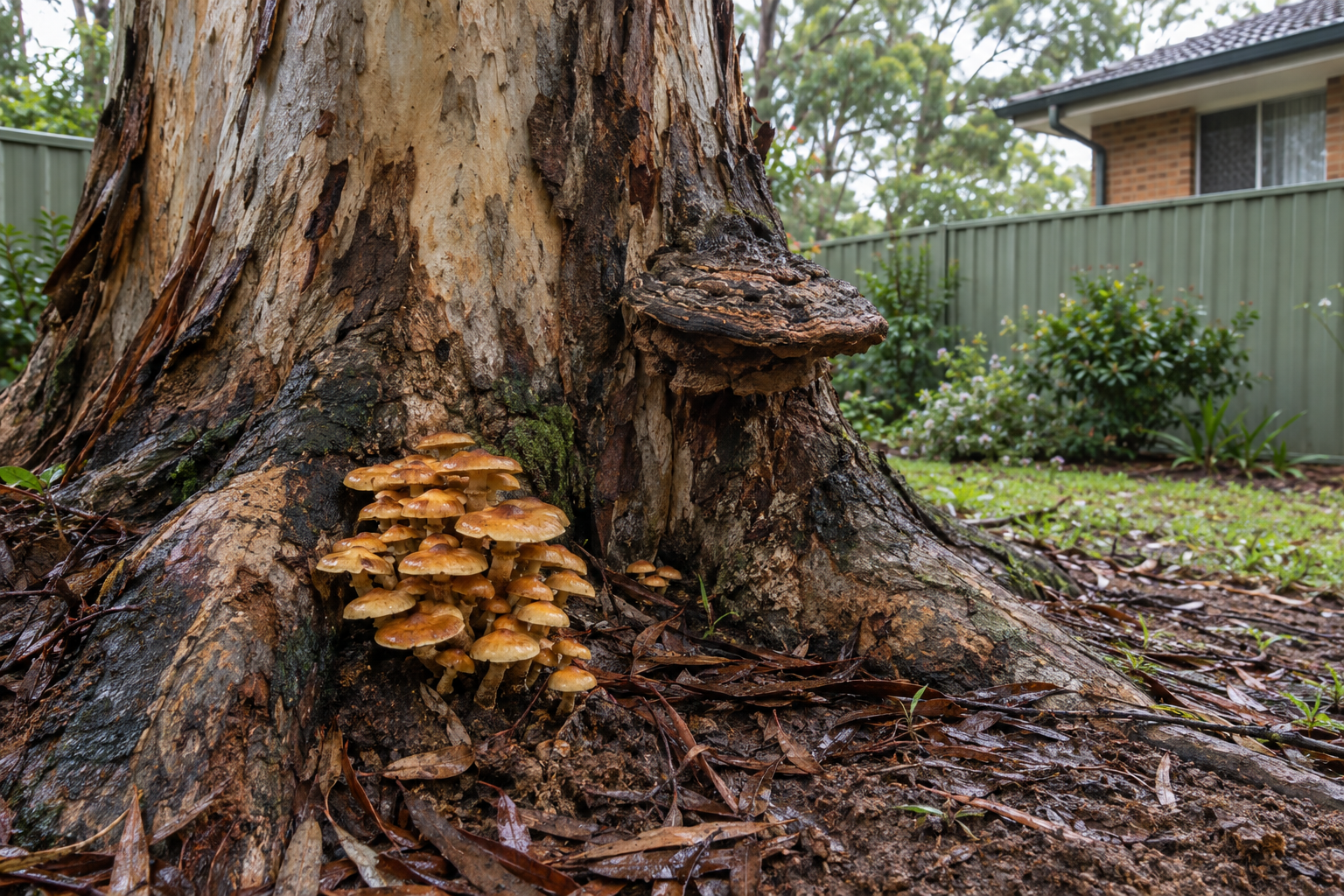
After a run of wet weather, a cluster of honey-coloured mushrooms has come up around the foot of the old gum beside the driveway. Or a hard brown shelf has appeared low on the trunk of the camphor laurel that has shaded the back deck since the house was built. Fungus at the base of a big tree is one of those things that can mean nothing much, or can mean the tree is quietly losing its grip on the ground.
Here is how to tell the difference, and what to do about it.
What you are actually looking at
The mushroom or shelf you can see is only the fruiting body. The fungus itself lives out of sight, as a network of threads running through wood, roots or soil. The fruiting body is how it spreads its spores, and it tends to appear after rain, which is why so many people notice it after a wet spell.
That matters because the size of what you can see tells you very little about what is happening inside. A small bracket can sit on top of a large area of decay. A big flush of mushrooms in the lawn can be feeding on nothing more than old mulch or a long-dead root.
Why the base matters more than the branches
Fungus on a high branch usually means a problem with that branch. Fungus at the base or on the root flare is a different question, because that is where the whole tree is anchored.
A tree stays upright through its root plate and the buttress where the trunk widens into the roots. If decay is working through either of those, the tree can look healthy above, with a full canopy and plenty of leaf, while its anchorage is weakening below. Trees in that state tend to fail at ground level rather than shedding a limb, and they tend to do it in strong wind or when the soil is saturated. In the Hills, that means summer storms and southerly busters, often after the ground has already been soaked.
The fungi worth taking seriously
Identifying fungi properly takes training, and even arborists will often want to see it in person rather than from a photo. As a general guide:
- Hard brackets or shelves on the trunk or root flare. These are usually wood-decay fungi, and their presence generally means there is decay in the wood behind them. Some, such as the Ganoderma group, are associated with decay at the base and in the roots. These are the ones to have looked at.
- Clusters of honey or tan mushrooms around the base, sometimes coming out of the trunk itself. This can point to Armillaria, a root-rotting fungus that occurs naturally in Australian bushland and can attack eucalypts and a wide range of garden trees. Other signs include white, fan-shaped sheets under loose bark at the base.
- Scattered mushrooms in the lawn a few metres out. Often harmless. They are commonly breaking down buried organic matter, old roots or the remains of a stump. Worth noting, not usually worth worrying about on their own.
The pattern matters more than any single mushroom. Fungus that is growing directly from the trunk or the main roots is a stronger signal than fungus growing near them.
Other signs to check alongside it
Fungus is one clue. An arborist will be looking for others, and you can do a first pass yourself from the ground:
- Cracks or splits in the trunk near the base
- Soil that has heaved, cracked or lifted on one side of the tree
- A lean that is new, rather than one the tree has always had
- Sections of bark that have died back, sunk or come away at the base
- Dark weeping or oozing from the lower trunk
- Dieback or thinning in the canopy, especially on one side
- Fine sawdust-like material collecting at the base
- A hollow sound when you knock on the lower trunk
One of these with a fungus is reason to get the tree assessed. Several together is reason not to wait.
Why it turns up on Hills blocks
Decay fungi usually get in through damage, and the way the Hills District was built creates plenty of it.
On the newer estates in Kellyville, Rouse Hill and Beaumont Hills, trees that were kept or planted during construction often had soil piled over their root zones, trenches cut through them for services, or heavy machinery parked on top. Damaged and compacted roots are an easy entry point, and the effects can take years to show.
On the older blocks in Castle Hill, Baulkham Hills and Winston Hills, the culprits tend to be driveways, retaining walls and extensions laid over roots decades ago, along with old pruning wounds and the stumps of trees removed long ago, which can harbour root-rotting fungi that spread to neighbouring trees.
Out on the acreage in Glenhaven, Dural and Kenthurst, the big blue gums and blackbutts carry storm wounds and old fire scars at the base, both of which let decay in. In Cherrybrook and West Pennant Hills, very tall trees over roofs on steep blocks mean the consequences of a root failure are higher than almost anywhere else in the district.
And across the Hills, heavy clay soils that stay wet after rain don't help. Roots sitting in waterlogged ground are more vulnerable to rot.
What not to do
A few common responses either do nothing or make things worse:
- Don't knock the fungus off and call it fixed. The fruiting body is not the problem. Removing it changes nothing inside the tree.
- Don't reach for a fungicide. Spraying the outside of a tree does not reach decay inside the wood or roots.
- Don't pile mulch or soil up against the trunk. Keeping the base wet encourages rot. Mulch should sit back from the trunk.
- Don't dig around the roots to have a look. Cutting or damaging roots opens more entry points.
- Don't assume it has to come down. Plenty of trees live with some decay for a long time. The question is how much, and where.
What an assessment looks at
A tree health assessment is carried out by a qualified arborist on site. They will look at the fungus, the root flare, the soil around the tree and the canopy, and sound the trunk to get a sense of whether it is solid. Where it is warranted, an arborist may use decay-detection equipment to estimate how much sound wood remains, or recommend a more detailed report.
The outcome is usually one of three things: the tree is fine and worth keeping an eye on; it can be kept with work to reduce the weight it carries; or the decay is advanced enough that removal is the safer option. If removal is on the table, check the rules before anything is booked. Don't assume decay changes what approval is needed, and remember the controls differ depending on whether you are in The Hills Shire, Hornsby or Parramatta. Our council tree approval guide explains how the system works.
Spring is a good time to look
In spring the canopy is leafing out and pushing new growth, which makes thin or dead sections easier to spot against healthy foliage. It also comes just before the peak storm months. If something is wrong at the base of a large tree, you want to know about it before the first summer storm tests it, not after.
If you have spotted fungus at the base of a tree, take a few photos: the fungus up close, the base of the trunk, and the whole tree from a distance so the canopy is visible. Send them through our quote form and we can give you a sense of whether it looks like something to have assessed.