
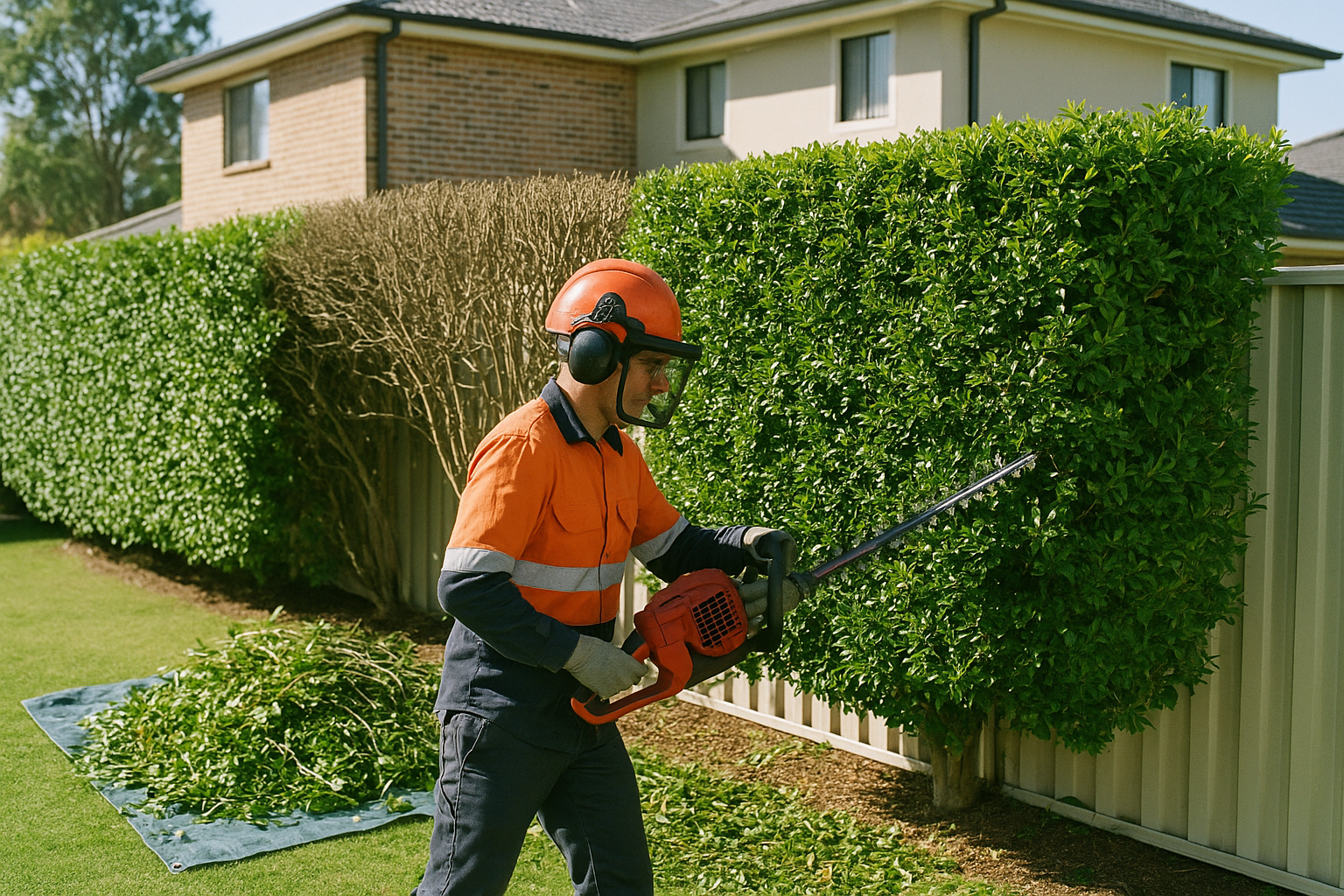
The screening hedge that went in when the estate was built is now a metre over the fence line, bare at the bottom, and pressing against the neighbour's Colorbond. The question everyone asks at that point is the right one: can it be cut back hard, or will it die brown and stay that way?
The honest answer is that it depends almost entirely on the species, and the difference between the two groups is not subtle. One lot reshoots from bare wood. The other lot doesn't, ever.
What a hard cut actually means
A maintenance trim takes the season's soft growth. The blade never leaves the green shell of the hedge, and the plant barely notices.
A hard cut goes past that shell into older wood — the grey or brown stems underneath, with no leaves on them. That's the cut people are nervous about, and rightly. Whether the plant recovers comes down to whether it carries dormant buds under the bark of old wood, waiting for light. Most broadleaf evergreens do. Most conifers don't.
That single distinction is behind most hedge disasters.
Hedges that usually come back
Lilly pilly (Syzygium and Acmena) is the workhorse of estate screening from Kellyville through Rouse Hill and Beaumont Hills, and it's forgiving. Cut it into bare wood and it usually reshoots along the stems, often with a flush of that bronze-pink new growth. Older plantings can be psyllid-prone; the newer cultivars were bred for resistance, which is worth knowing if you're replacing rather than saving.
Murraya takes a hard reduction well in most cases and reshoots from old wood. It's everywhere in the Hills as a front-boundary hedge, and it's frequently the plant people have let run to three metres because it flowers and smells good.
Photinia — the red-tip robin — is close to indestructible and generally responds to a hard cut with a burst of new red growth. Same for viburnum odoratissimum, which is the other default screening hedge in newer estates and shoots readily from bare stems.
Callistemon and melaleuca hedges carry epicormic buds under the bark, the same mechanism that lets a gum reshoot after fire, so they usually break new growth low down after a hard reduction.
Pittosporum is the one to hedge your language on. Silver sheen and the variegated forms will often reshoot from old wood, but the response can be patchy and slow, and a plant that's already stressed by drought or root competition may only come back on one side.
Box reshoots, but at box speed. A hard cut on an established buxus border will take more than one growing season to look right again, so stage it if you can.
Hedges that usually don't
Conifers are the big one. Leighton green cypress, other cypress varieties, junipers, thuja — the classic tall privacy screens planted along the back fences of 1980s and 90s blocks. Cut them back past the green and you're into dead-looking brown interior wood that stays exactly that way. There are no dormant buds there to wake up. You get a brown wall on the side you cut, permanently.
With a conifer screen the only sustainable approach is to keep it inside the green each time and accept that once it's wider or taller than you want, it's a removal-and-replant conversation rather than a pruning one.
Camellia and magnolia hedges mostly don't recover from a genuine hard cut either. Sasanqua camellias are common as narrow screening down side passages in Castle Hill and Baulkham Hills, and the little-leaf magnolia cultivars have become popular in newer builds. Both can be reduced gently and shaped, but taken back into thick bare wood they tend to sulk, respond thinly, or not respond at all.
Westringia and gardenia sit in the same bracket. They're fine with regular light trimming and poor with a reset.
Bamboo isn't a hedge problem, it's a containment problem, and cutting it back does nothing about the runners.
How to test before you commit
If you don't know what you've got — and plenty of people inherit a hedge with the house — there are two checks worth doing before anyone starts.
- Look inside. Part the foliage and look at the interior stems. If you can see small green shoots or leaf buds already breaking on old wood in the shaded middle of the plant, it's telling you it will reshoot. A completely dead, twiggy, leafless interior on a conifer is telling you the opposite.
- Cut one section first. On a long run, take a metre of it back to the height you're considering and leave the rest. Give it a full growing season. If that section fills in, do the rest with confidence. If it doesn't, you've disfigured one metre instead of twenty.
Staging is the other option: take a third off, let it respond, take the next third the following year. It's slower and it costs more over time, but for a valuable screen you can't afford to lose, it's the sensible route. A hedge trimming visit can be planned that way rather than as one big reset.
Why spring timing matters
Cut hard in spring and the plant is heading into its growth period with warming soil and increasing daylight. That's the best window for a reset on anything that reshoots, because the recovery happens while conditions are in the plant's favour.
Cut hard going into winter and the bare wood sits there exposed for months. Up on the higher ground around Glenhaven, Kenthurst and Middle Dural, where frost settles in the hollows on clear nights, freshly exposed interior wood on a tender species is the last thing you want.
The other spring factor is water. A hedge that's been hard cut is running on stored energy and needs consistent moisture at the roots to push new growth. Deep watering at the base beats a light spray over the foliage, and a layer of mulch pulled back off the stems helps hold it in through the first hot westerlies.
Bare at the bottom is a light problem, not a pruning problem
A hedge that is bare at the bottom is often short of light rather than short of a pruning. A hedge trimmed square or, worse, narrower at the base than the top, shades its own lower foliage until it drops. The bottom metre goes twiggy and see-through, which is exactly the bit you wanted for privacy.
The fix is shape. Keep the hedge slightly wider at the base than at the top, so the whole face gets light. It looks marginally odd on paper and completely normal once it's grown in, and it's the difference between a screen that stays furnished to the ground and one that turns into a row of bare legs with a hat on.
The same applies in tight Kellyville side passages where a hedge is fighting a fence on one side and a wall on the other. If it only gets light from above, no amount of cutting will make the bottom fill in.
When the hedge stopped being a hedge
On plenty of older blocks the screening row was planted thirty years ago and never controlled. Individual plants are now single-stemmed, several metres tall, and structurally trees in everything but name.
That's a different job, and it can be a different set of rules. Once a plant reaches a certain size it may fall under local tree controls rather than being ordinary garden maintenance, and that varies by property and by council — Cherrybrook sits with Hornsby Shire while most of the district is The Hills, and boundary suburbs can go either way. Our page on council tree approval explains how the system works and when a check is worth making before anything is cut.
What to do next
Identify the species first. If it's lilly pilly, murraya, photinia or viburnum, a hard cut in spring is usually a reasonable risk and the plant does the rest. If it's cypress, camellia or magnolia, plan around the green shell or plan a replacement, because there's no version of a hard cut that ends well.
If you're not sure what's in the ground, send a few photos — the whole run from a distance, plus a close-up of the interior stems with the foliage parted — and we'll tell you what we think you're dealing with and give you a ballpark. Send them through here.