
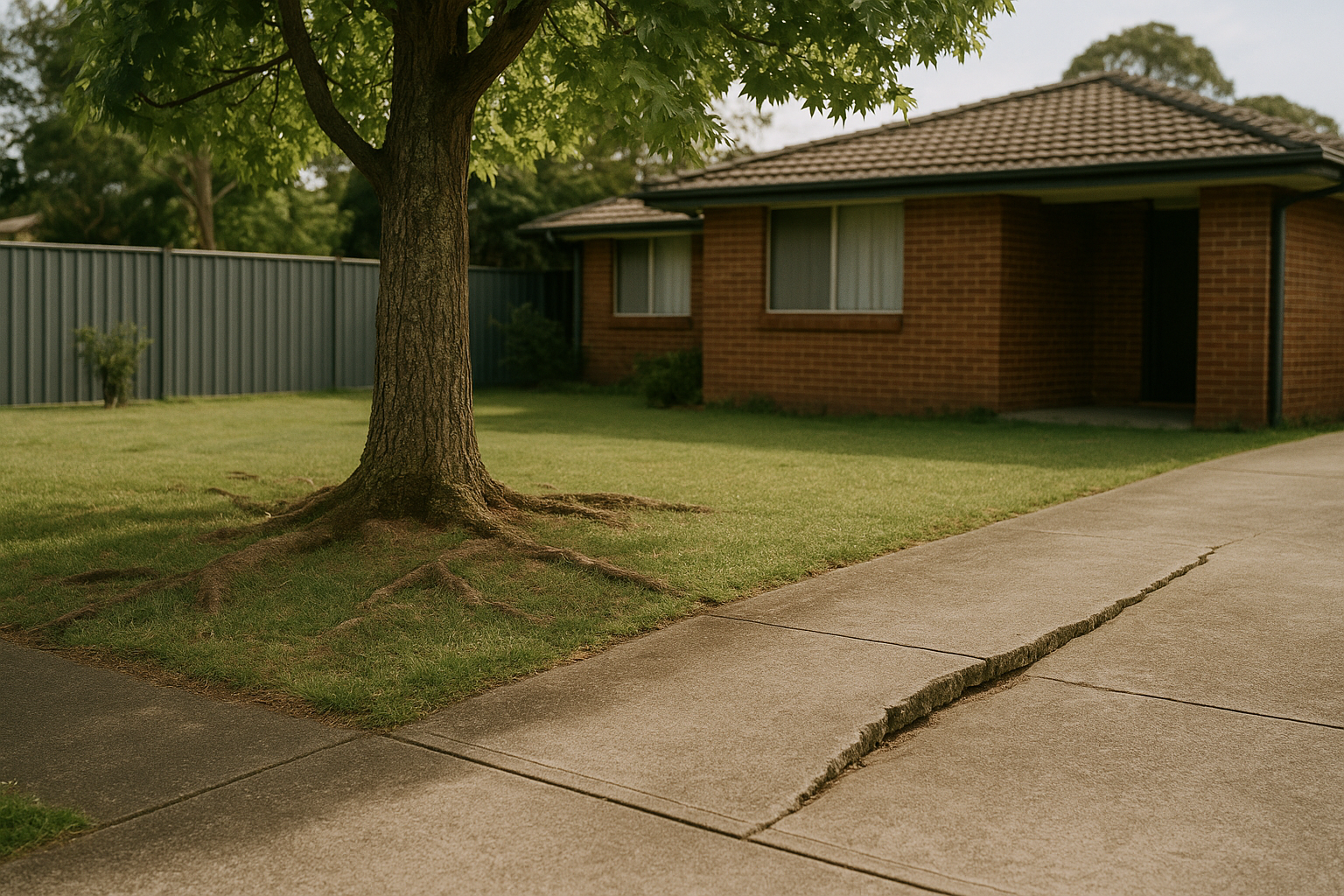
There is a particular crack that turns up on 1970s blocks all over the Hills: a ridge running across the concrete driveway, about a third of the way up from the kerb, with a liquidambar standing in the front lawn a few metres away. Once you notice the crack follows a line back towards the trunk, you know what caused it.
Liquidambars were a standard street-and-front-yard choice across Castle Hill, Baulkham Hills and Winston Hills when those estates went in. They were cheap, fast, gave good shade by year ten and turned red in autumn. Nobody was thinking about what the roots would be doing fifty years on.
Why this species in particular
Liquidambar roots run shallow and wide. The species puts most of its structural roots in the top layer of soil, spreading outwards rather than down, and the big ones near the trunk — the buttress roots — thicken every year for the life of the tree.
Concrete makes it worse rather than better. A driveway slab keeps the soil under it cool and moist and shades out competing turf, so roots tend to track along underneath it instead of avoiding it. Once a root is under the slab and growing in girth, something has to give, and it is never the root.
The Hills clay soils add to it. Shrink-swell clay moves seasonally on its own, and a driveway poured decades ago over that clay, with whatever reinforcement was standard at the time, does not have much tolerance left by the time a root arrives.
How to tell it is actually the tree
Not every cracked driveway is root damage. A few things point to the tree rather than the slab:
- The lift is a ridge or a hump, not a settlement dip. Roots push up; failing subgrade drops down.
- The crack runs roughly at right angles to a line drawn from the trunk, or curves in an arc around it.
- The worst of it is on the side of the driveway nearest the tree and fades as you move away.
- There is surface rooting visible in the lawn nearby, or the turf beside the driveway is hard to mow because it sits over ropey roots.
- Paths, kerbs or the neighbour's slab on the same side show the same pattern.
If the damage is in the middle of a wide driveway with no tree within ten metres, look at drainage and the original build before blaming anything green.
Can you just cut the root out?
Sometimes. Often not. It depends almost entirely on how big the root is and how close to the trunk you would be cutting.
The general principle in arboriculture is that the closer a root is cut to the trunk, and the larger its diameter, the more of the tree's stability and water supply goes with it. Cut a major buttress root on one side of a liquidambar and you have removed a structural leg on that side. The tree may look fine for a couple of years and then lean or fail in a westerly. You also open a large wound at ground level, on a species that is not especially good at compartmentalising decay, in soil that stays damp.
Smaller roots further out are a different matter. A qualified arborist can assess which roots can go, where a clean cut should be made, and whether a root barrier installed at the same time is worth doing to slow re-growth on that side. The honest answer for any individual tree is that it needs someone standing next to it with a shovel and a look at the trunk flare, not a rule of thumb from the internet.
One thing that does not help: reducing the canopy in the hope of shrinking the roots. Crown work changes what the tree does above ground. It does not retract the root that is already under your concrete.
The options, in order of cost
Live with it and manage the trip hazard. If the lift is minor and the driveway is otherwise sound, grinding the raised edge down or ramping it with asphalt buys years. Cheap, reversible, and does nothing to the tree.
Re-lay the affected section over the root. A new slab can be poured or a section replaced with pavers or flexible paving that sits above the root with a compressible layer between. Pavers are the more forgiving option because individual units can be lifted and re-bedded later instead of the whole thing cracking again.
Selective root pruning with a barrier. Worth investigating where the roots involved are secondary rather than structural. It is a delay rather than a cure, and it should follow an assessment rather than a decision made with a mattock on a Saturday.
Remove the tree. The honest option when the root causing the damage is a main buttress root, the driveway needs replacing anyway, or the tree has other problems stacking up — decay at the base, a history of limb drop, or a canopy that has outgrown a front yard three metres from the house. That is a tree removal conversation, and access matters as much as size: a front-yard liquidambar with a clear kerb and no powerlines above it is a very different job from one wedged between a house and a neighbour's fence on a narrow side boundary.
What happens to the roots after removal
This part surprises people. Removing the tree does not remove the roots. Stump grinding takes the stump down 200–300 mm below the surface and chews out the root flare around it, but lateral roots running under a driveway stay where they are. They stop growing, which stops the damage getting worse, and they decay over a period of years.
That matters for sequencing. If you are replacing the driveway, get the tree down and the stump ground first, then let the concreter excavate and deal with what is under the slab while it is open. Doing it the other way around means cutting a new driveway to get a grinder through.
Before you book anyone, check the tree's status
Established trees on Hills District blocks are often covered by council tree controls, and a mature liquidambar in a front yard is exactly the sort of tree those controls exist for. The controls vary by property and by council — most of the service area sits with The Hills Shire, while Cherrybrook is Hornsby and parts of West Pennant Hills and Winston Hills straddle a boundary — so the answer for your street is not necessarily the answer for the next suburb across. We have set out how the approval system works and what councils generally ask for on our council tree approval page. Damage to a driveway is the kind of thing councils will look at, but it usually needs to be supported by an arborist's assessment rather than a photo of a crack.
Spring timing
Spring is the active growth period, so if the lift has moved since last year, it will most likely keep moving over the warm months. It is also when the westerlies start and the first storms come through, which is the season stability matters most — another reason not to take a large root off a mature tree without advice.
One practical job while you are looking at the tree anyway: liquidambars drop their spiky gumballs through late summer and autumn, and they roll straight into gutters, downpipes and stormwater pits. If you are about to spend money on a driveway, check the drainage around it at the same time.
If you have a liquidambar and a driveway that is losing the argument, send us a few photos — the crack, the trunk from the kerb, and a wide shot showing how close the tree is to the slab — and request a quote so we can give you a ballpark and tell you whether this needs an arborist on site.