
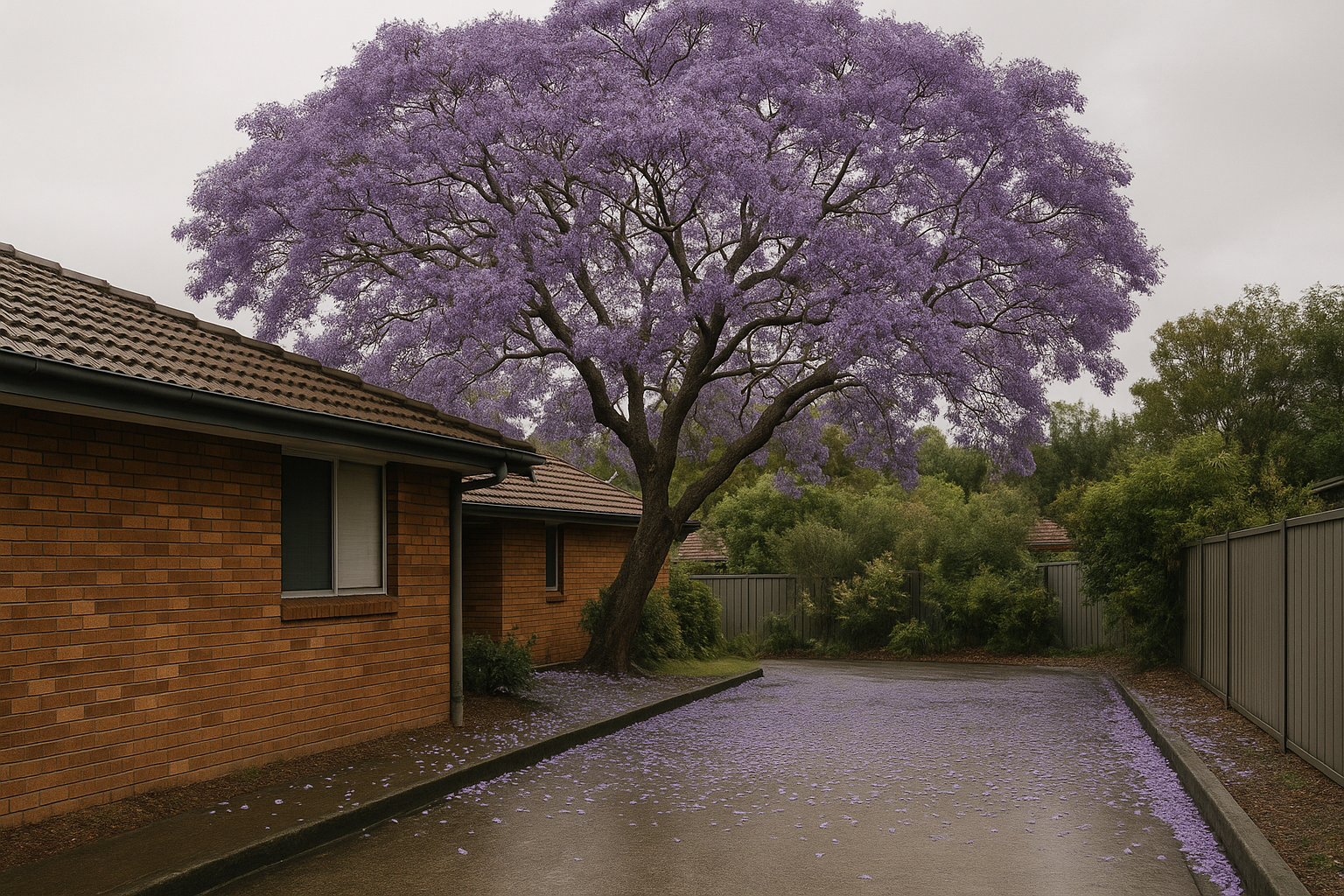
The purple carpet under a jacaranda in Baulkham Hills looks wonderful until the first wet afternoon. Then the flowers turn to brown mush across the driveway, the downpipe backs up, the car under the carport is spotted with sticky residue, and someone in the house asks whether the tree has to go.
Usually it doesn't. But it helps to know what the tree actually does across a year, where the mess really comes from, and why the most common fix, cutting it hard, tends to make everything worse.
Why so many older Hills blocks have one
Jacarandas were a favourite street and backyard tree when much of Castle Hill, Winston Hills and Baulkham Hills was built out in the 1960s to 80s. They grow quickly, they flower reliably in Sydney's climate, and a young one looks tidy on a new block.
A few decades on, those trees are wide and tall, often planted closer to the house, the driveway or the boundary than anyone would choose today. On the newer estates in Kellyville and Rouse Hill they're less common, and the ones you do see tend to be younger and sit on smaller blocks, where the canopy reaches the neighbour's roof sooner.
What the flowers do to gutters and downpipes
Jacaranda flowers are small, soft and fall in huge numbers over the flowering period in late spring. On their own, dry, they're light and mostly blow around. The problem is timing.
Late spring is also when the first proper storms come through the Hills. Rain knocks down a heavy drop all at once, and wet flowers:
- mat together into a dense layer in the gutter that water sits on top of rather than draining through
- get carried to the outlet and pack into the downpipe
- clog the fine mesh of gutter guards, so the guard itself becomes the blockage
- break down quickly into a sludge that's harder to flush out than dry leaves
A blocked gutter in a light shower is a nuisance. A blocked gutter in a spring storm can overflow back under the roof edge or into the eaves. If there's a jacaranda over the roof, the gutters are worth checking at the start of flowering and again after the drop has finished, not just in autumn.
The sticky car and the slippery path
The flowers carry nectar, and fallen blooms leave a tacky residue on cars, outdoor furniture and pool covers. Left to bake in the sun it's harder to shift, so a hose-down every few days during the drop saves scrubbing later.
On paving and concrete, flowers can leave a faint stain, particularly on pale or unsealed surfaces. It usually weathers out, but sealed pavers cope better than porous ones.
The bigger issue is footing. A layer of wet flowers on a sloping driveway or a set of outdoor steps, common on the hillier streets of Castle Hill and Winston Hills, is genuinely slippery. A stiff broom or leaf blower after rain is the practical answer, especially where older people or kids use the path.
It isn't only the flowers
People tend to blame the purple drop for everything, but a jacaranda sheds something through most of the year:
- Leaves. Jacarandas usually drop much of their fine, fern-like foliage in late winter to early spring, just before flowering. The leaflets are tiny and slip straight through many gutter guards.
- Seed pods. The round, flat, woody pods form after flowering and drop over the following months. They're hard underfoot and can sit in gutters for a long time without breaking down.
- Twigs and small branches. Normal for any tree, and more noticeable after wind.
So if gutters under a jacaranda seem to need attention constantly, that's why. It's a tree that asks for regular, small maintenance rather than one big clean-up.
Pruning a jacaranda without ruining it
A well-shaped jacaranda can be kept at a sensible size, but it needs a light touch. Good pruning to AS 4373 on a jacaranda usually means:
- removing dead, crossing or rubbing branches
- lifting the lower canopy to clear a roof, driveway or path
- reducing individual limbs back to a suitable side branch, rather than cutting through the middle of a branch
- thinning selectively so wind moves through the crown
Timing matters. Light pruning is commonly done in late winter, before the tree puts on its new growth, or after flowering. Heavy cuts at almost any time tend to cost flowering for a season or more.
A qualified arborist doing tree pruning on a jacaranda over a roof will usually aim to pull the canopy back off the gutters and tiles, which reduces how much lands on the roof, without trying to shrink the whole tree in one go.
Why lopping makes it worse
The common response to a jacaranda that's got too big is to have it lopped: cut all the main limbs back to stumps. We don't top or lop trees, and jacarandas are one of the clearest examples of why.
A jacaranda responds to heavy cuts by throwing up a mass of vigorous, upright water shoots from just below each cut. Within a couple of seasons you have a tree shaped like a broom, often taller and denser than before. Those shoots are weakly attached to the old wood, so they're more likely to break out in a storm. The cut ends are also slow to seal, which leaves the tree open to decay.
The tree also tends to stop flowering properly while it pours energy into regrowth. So lopping usually leaves you with more mess from shoots and pods, less of the purple you liked, and a tree that needs cutting again soon.
If the tree is simply too big for where it is, reduction over two or three pruning cycles is usually better than one hard cut. If that still won't make it fit, removal may be the honest answer.
Should it go?
That depends on a few things you can mostly judge from the ground:
- Where it is. A jacaranda in the middle of a big Castle Hill backyard is a different proposition to one hard against the house, over the pool or leaning onto the neighbour's roof.
- Its condition. Dead limbs, cracks, decay at old lopping cuts, or fungus at the base are worth having looked at.
- Its history. A tree that's been lopped before often carries weak regrowth that's more of a risk than the original tree.
- What you want from the space. Some people love the flowering enough to live with the mess. Others want the gutter and the solar panels clear.
If removal is on the table, check the rules first. Whether a jacaranda needs approval depends on the council's controls for your property, and in suburbs like Winston Hills that straddle a boundary it's worth confirming which council you're under. Our council tree approval guide explains how the process works and what to check before booking anyone.
What to do before the next flowering
If there's a jacaranda over your roof or driveway, the useful jobs are simple: get the gutters cleared before the flowers start, keep the canopy lifted clear of the roof and paths, and have any pruning done lightly, at the right time, by a qualified arborist rather than whoever knocks on the door with a chainsaw.
If you'd like a ballpark on pruning or removal, send a few photos showing the whole tree, what's underneath it and the access to the backyard through our quote form.