
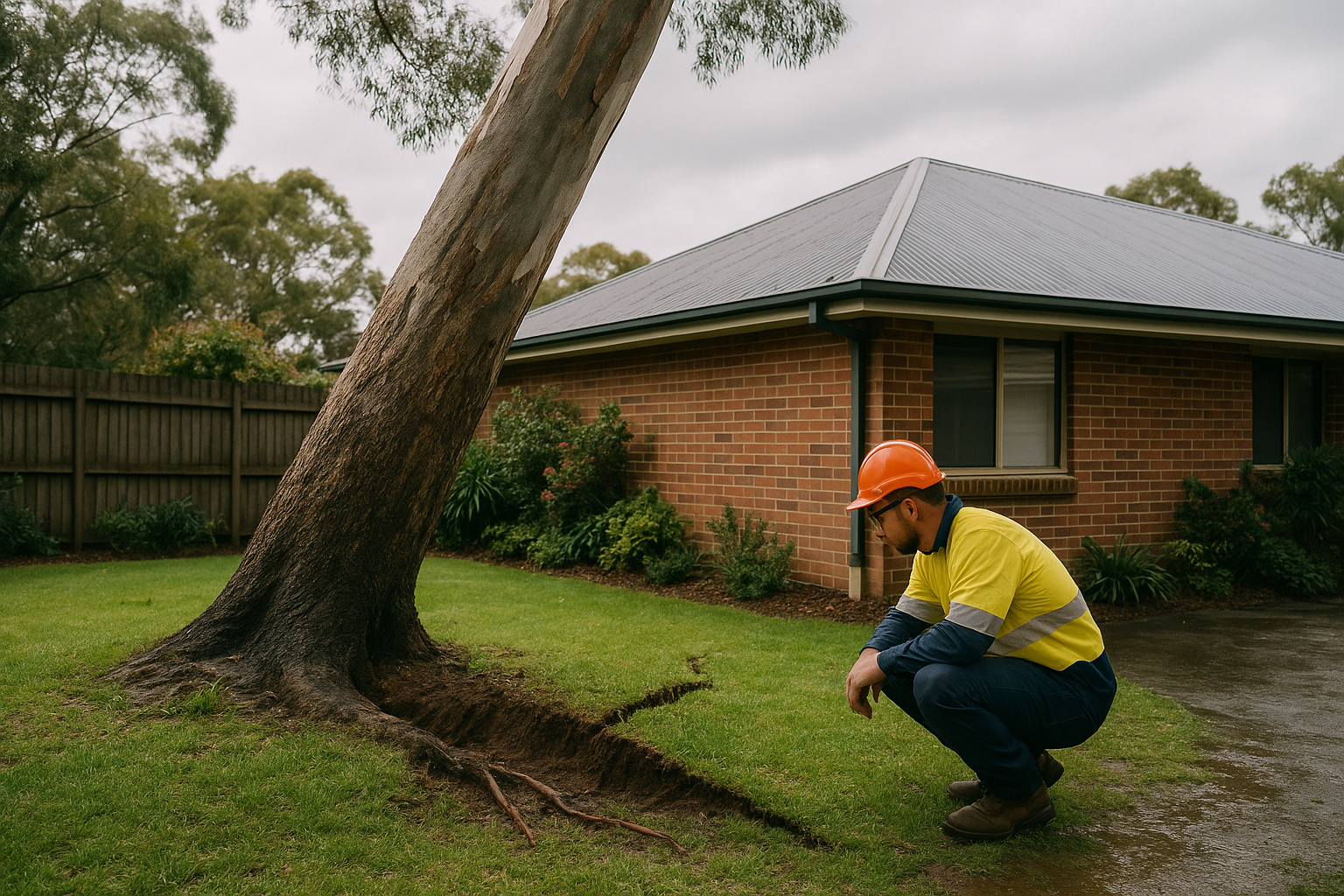
The gum at the back fence has always had a bit of a tilt toward the house, and nobody thought twice about it. Then a wet week and a gusty westerly come through, and it looks like it is tilting more. Or the screening tree along a Kellyville side boundary that stood straight for years is suddenly resting on the Colorbond.
Those two situations look similar from the kitchen window. They are not the same problem, and the difference between them is worth understanding before spring storm season gets going.
Most leaning trees are perfectly stable
Trees grow toward light. On a 1970s Castle Hill or Baulkham Hills block, a gum that came up beside a taller neighbour or under the eaves will often have grown out at an angle to find the sun. Over decades it builds extra wood on the side that needs it, and its roots develop to hold that shape.
A tree like that has had its whole life to adapt. The lean is part of how it is built. It still needs the usual checks for deadwood, cracks and decay, but the angle on its own is rarely the reason to worry.
A new lean means something has moved
When a tree that used to stand upright starts to lean, the tree has not grown into a new shape. Something underneath it has shifted. In most cases that is the root plate, the mass of roots and soil that anchors the tree, partly lifting or tearing on one side.
That is why a recent lean is treated so differently. The tree has not adjusted to it, the roots holding it are likely damaged, and the next strong gust or heavy downpour can finish what the last one started. A root plate failure usually brings down the whole tree, not a branch.
How to tell an old lean from a new one
You can learn a lot from a careful look, from a safe distance first.
Look at the shape of the trunk
- Curved trunk, upright top. If the trunk bends and the crown turns back toward vertical, the tree has usually been correcting itself for years. That points to an old lean.
- Straight trunk, tilted as a whole. If the trunk is straight but the entire tree is on an angle from the ground up, it has more likely moved at the base. That points to a new lean.
Look at the ground
Walk to the side opposite the lean, the side the roots are being pulled up from, but only if you can do it without standing under the tree or in the direction it is leaning.
- Cracked or raised soil in an arc around the base
- Lawn lifting like a lid, or a ridge of soil that was not there before
- Exposed or snapped roots
- A gap opening between the trunk and the soil
- Paving, edging or a garden bed that has heaved on that side
Any of these alongside a lean is a strong sign the root plate is moving.
Compare with something fixed
A fence post, a downpipe or the edge of a brick wall makes a decent vertical reference. Line the trunk up against it from the same spot each time. Old photos are even better. Phone galleries are full of backyard shots, and a picture from last summer will often settle the question in a few seconds.
Why it tends to happen in the Hills
A few local conditions make new leans more likely here than in some other parts of Sydney.
Wet soil, then wind. Much of the Hills sits on heavy clay. When it is saturated after prolonged rain it loses a lot of its grip, and if a strong westerly or the first spring storm arrives before it dries out, a tree can rock in its own root zone. That combination of soaked ground and wind is one of the most common triggers for a sudden lean.
Building work next door. In Box Hill, North Kellyville and the newer parts of Rouse Hill, a lot of trees sit close to boundaries where neighbours are digging pools, pouring slabs, trenching for services or putting in retaining walls. Cutting through roots on one side of a tree can weaken its anchorage without anyone noticing until it moves. The same applies on older blocks when a driveway is replaced or a new pool goes in.
Slopes. In Cherrybrook, West Pennant Hills and parts of Glenhaven, steep and battle-axe blocks mean tall trees standing on sloping ground. Soil on a slope can creep or slump after heavy rain, taking the tree with it. A big blue gum leaning toward a roof downhill is the kind of thing that should not wait.
Fast growth in the wrong spot. On the smaller estate blocks, screening trees planted in narrow beds beside a fence often have roots hemmed in by the slab on one side and the fence footings on the other. As the canopy gets taller and heavier, a cramped root system can struggle to hold it in a strong wind.
What to do if your tree has started leaning
First, keep people out of the way
A rough rule is that a falling tree can reach about as far as it is tall, and further if it hits something and breaks. Keep children, pets and cars out of that zone, especially on the side it is leaning toward. If it is leaning over the house, avoid using the rooms underneath it until someone qualified has looked at it.
Do not try to fix it yourself
Propping a tree with timber, tying it back to another tree or winching it upright with a car can make things worse. It loads damaged roots in ways nobody can predict and puts whoever is doing it right in the fall zone. Climbing it with a chainsaw to take weight off the top is more dangerous again.
Stay clear of powerlines
If the tree is leaning toward or touching overhead lines, do not go near it, keep everyone well back, and call your electricity distributor, who will tell you how far to stay away. Nobody without specific electrical clearances should be working near those lines.
Get it assessed
If the lean is clearly recent and the ground is cracking or lifting, treat it as urgent. Our emergency storm damage service covers trees that have moved and are threatening a house, fence or driveway.
If you are not sure whether the lean is new, or the tree looks stable but you want a qualified opinion, a tree health assessment is the sensible step. A qualified arborist will look at the root zone, the trunk, the crown and the site, and tell you whether the tree can stay, needs work to reduce the load on it, or needs to come down.
Does a leaning tree need council approval to remove?
That depends on your council, the tree and how dangerous it is, and it is not something to guess. Councils generally have provisions for trees that pose an immediate risk, but what counts and what paperwork follows varies. Our page on council tree approval explains how the approval system generally works. Check with your own council before any work is booked, and keep in mind that an arborist's assessment is usually the document that matters if a lean is the reason for the work.
Some leaning trees do not need to come out at all. A long-established lean on a healthy tree can sometimes be managed with crown reduction to take weight off the heavy side. That is a call for an arborist on site, not one to make from the back step.
Send us a photo
If the ground around the base is cracking or the tree is visibly moving, do not wait on photos. Keep everyone clear and treat it as an emergency.
If it is a slower worry, take a few photos from a safe distance: one of the whole tree, one of the base and the ground around it, and one showing what it is leaning toward. An older photo for comparison helps too. Send them through our quote form and we'll come back with a ballpark and whether it needs an arborist on site.