It is thirty-four degrees, the air has not moved all afternoon, and a limb the size of a small tree is lying across the lawn. No storm, no wind, no warning — and the rest of the canopy looks perfectly healthy from the back deck.
This catches Hills District homeowners off guard more than storm damage does, because storm damage at least makes sense. A limb failing in dead calm feels like the tree broke a rule.
It has a name, and the cause is not fully settled
Arborists call it summer branch drop, or sudden limb failure. It describes a large, often horizontal limb detaching from an apparently sound tree on a hot, still day, usually in the afternoon or early evening after a run of heat.
The pattern is well recognised. The mechanism is still argued about. The explanations that get the most support involve heat and water: on a very hot, windless day the tree is losing moisture fast through the leaves, internal moisture content in the limb changes, and a long heavy branch that was already carrying a hidden defect reaches the point where the wood fails. Some limbs also cool unevenly after a hot day, which puts stress across the wood.
What matters for a homeowner is less the physiology and more this: it tends to happen to big, long, heavily loaded limbs, and it happens to trees that looked fine.
Which trees do it around here
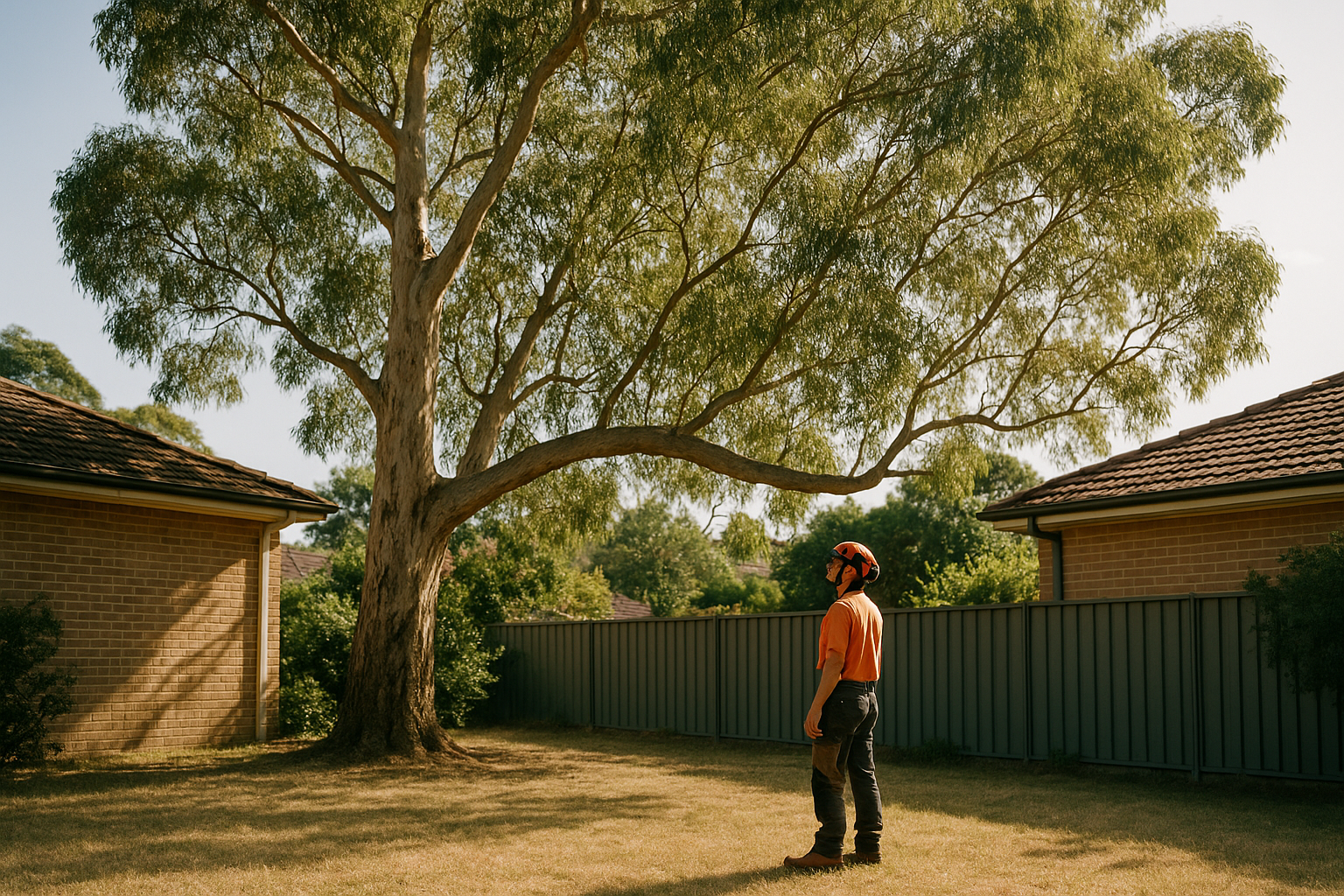
Eucalypts are the usual suspects, and the Hills has them everywhere. The big blue gums and blackbutts left standing on acreage at Glenhaven, Dural and Kenthurst. The remnant canopy that estates at Cherrybrook and West Pennant Hills were built into, where sixty-year-old trees stand over tiled roofs and pools. The gums planted in Castle Hill and Baulkham Hills backyards in the 1970s that nobody expected to reach twenty-five metres.
Angophoras do it. Spotted gums do it. It is not exclusive to natives — large oaks, elms and other broad-crowned trees can shed limbs the same way — but in this part of Sydney the tree involved is usually a eucalypt, because that is what is tallest and oldest on most blocks.
The limbs most likely to go are the ones that are long, close to horizontal, extend well beyond the main body of the canopy, and carry a lot of foliage out at the end. A branch like that is a lever. Everything the tree adds to the outer end multiplies the load at the attachment point.
Why spring is the wrong time to relax about it
The classic summer branch drop day is a hot, still one in the middle of summer. But spring is when the loading changes.
After winter dormancy the canopy flushes. New leaves and new extension growth go on at the ends of the limbs, and that is exactly where extra weight does the most damage to an already overextended branch. Add the first genuinely hot northwesterly days, add spring rain soaking the foliage so the whole crown is heavier for a few hours, and a limb that was marginal through winter is carrying noticeably more by the time the first real heatwave arrives.
Spring is also the practical window. Lead times are shorter before the storm season, and any work you want done to a big tree over a house is easier to organise before summer than in the middle of it.
What you can actually see from the ground
You cannot predict a sudden limb failure. Anyone who tells you otherwise is overselling. What you can do is find the limbs that are carrying the most risk, which is a different and more useful job. From the lawn, with binoculars if the tree is tall:
- Long horizontal limbs that reach well past the rest of the canopy, especially ones sitting over a roof, a pool, a driveway or a trampoline.
- Dead wood in the upper crown. Dead limbs are usually the first thing out of a tree in wind, and they come down in calm weather too.
- Old failure scars. If this tree has dropped a limb before, that tells you something about how it is built.
- A narrow, V-shaped union with bark pinched inside it. Included bark makes a weaker attachment than a broad, U-shaped fork.
- Cracks, seams or bulges along a major limb, or a section where the bark looks different to the rest.
- Fungal brackets or mushrooms at the base, on the trunk, or at a branch union — worth looking at properly rather than ignoring.
- Dense clumps of epicormic shoots sprouting off an old cut or along a bare limb, which usually indicate the tree has been stressed or previously topped.
None of these on its own means a limb is coming down. A combination of them over something you care about is the point at which it is worth getting a set of eyes up in the tree. A qualified arborist inspecting the crown properly will pick up things that are simply not visible from below — the state of a union, decay behind an old wound, how far a crack actually runs.
What reduces the risk, and what makes it worse
The genuine answer is selective, targeted pruning, and it is a smaller job than most people expect.
Reducing the end weight on an overextended limb — shortening it back to appropriate lateral growth, thinning the foliage at the outer end — takes load off the lever without gutting the tree. Removing dead wood takes out the material most likely to fall on a still day. Both are done to AS 4373, which sets out where the cut goes so the wound can seal rather than sit open and rot. That is standard pruning work on a mature tree, not surgery.
What makes it worse is topping. Cut a big gum back to stubs and it responds with a mass of fast, vigorous epicormic shoots attached to the outside of the old wood rather than growing from a proper union. Within a few years you have a heavier crown made of weaker attachments sitting on top of decaying stubs. We don't top or lop, and a tree that has been lopped in the past is one of the reasons a limb fails years later.
It is also worth being honest about the other lever: what sits underneath. Risk is the chance of failure multiplied by what it lands on. Moving the trampoline out from under the one big horizontal limb costs nothing and changes the outcome more than half the pruning options do.
The paperwork sits in front of the work, not after it
Large established trees in The Hills Shire, and in Hornsby Shire where Cherrybrook sits, are generally subject to council tree controls — and those controls can cover significant pruning, not only removal. Whether a particular tree on a particular block needs approval depends on the tree and the property, and the council's own controls are the thing that settles it. Our page on council tree approval in the Hills walks through how the process works, and an arborist report is usually what council wants when the question is genuinely arguable.
Start that early. Applications move faster outside the storm rush, and there is no point booking a crew for a job that has not been approved.
If a limb has already come down
Don't take the failure as the end of it. A limb tearing out often takes bark and wood off the trunk with it, leaving a wound that becomes an entry point for decay — and the limb that failed may not be the only one built that way. It is worth having the rest of the crown looked at properly, particularly the limbs on the same side of the tree, before the next hot spell.
If you have a big gum with a long limb over the roof and a hot summer in front of it, send us a few photos from different angles and a note about what's underneath it, and we'll come back with a ballpark and a free quote.